
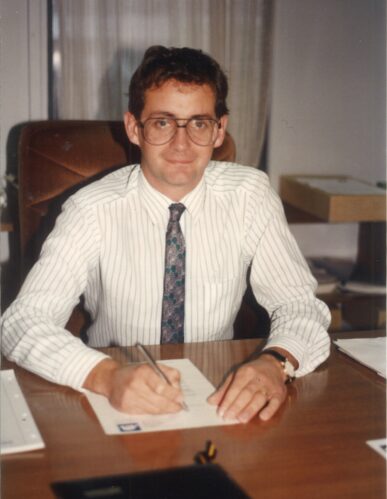
McKay Managing Director Lindsay Faithfull may have been born into electrical work, but his early interests leaned toward history and the arts. That changed one Christmas when, watching Noel Driver and his father Joe Faithfull fix caravan electrics, he realised he wanted those skills himself. He began his apprenticeship in 1977 and completed it in 1980, quickly developing a reputation for practical thinking—learning early on that even complex problems often have simple solutions.
Alongside his trade, Lindsay completed his NZCE before earning an engineering degree with Honours from University of Canterbury. After gaining experience on refinery projects, he spent several years in the UK working across major oil, gas, and water developments, reaching Principal Engineer level.
In 1992, he returned to New Zealand at his father’s request to help lead McKay as General Manager and shareholder. What he came back to was a business under pressure—just 35 employees, limited workflow, and operating in a tough economic climate. Two years later, in 1994, Lindsay stepped into the role of Managing Director, taking on the challenge of turning the company around.
The early focus was simple but critical: win work, rebuild confidence, and restore stability. That meant sharpening tendering, strengthening customer relationships, and getting back in front of clients. It was a hands-on period, with a clear understanding that without consistent work, nothing else mattered.
The turning point came in 1995, when McKay secured a major streetlighting contract—edging out a long-standing incumbent. It was a pivotal win, not just for the revenue it brought, but for what it signalled: McKay was back in the market, competitive, and capable of securing long-term, stable work. It marked the beginning of a shift away from purely cyclical construction toward more predictable maintenance contracts.
From there, momentum built. Through the late 1990s and early 2000s, McKay expanded into new sectors, particularly marine, growing from small projects into major work on naval vessels and superyachts, including the landmark Cakewalk project in the United States. At the same time, the business invested in in-house switchboard manufacturing—strengthening capability and creating a platform for further growth, including acquisitions.
Over time, Lindsay helped transform McKay into a more diversified and resilient business spanning marine, infrastructure, manufacturing, and renewables. The later launch of the renewables division marked another step forward, positioning the company within New Zealand’s growing solar sector.
Today, McKay is significantly larger and more complex than the business Lindsay returned to in 1992. Reflecting on that journey, Lindsay credits its success not to any single milestone, but to consistently doing the basics well—building relationships, learning from mistakes, and focusing on people. Looking ahead, he sees rapid change driven by technology and sustainability, but remains clear on one constant: people will stay at the centre of the business.