INTERNATIONAL
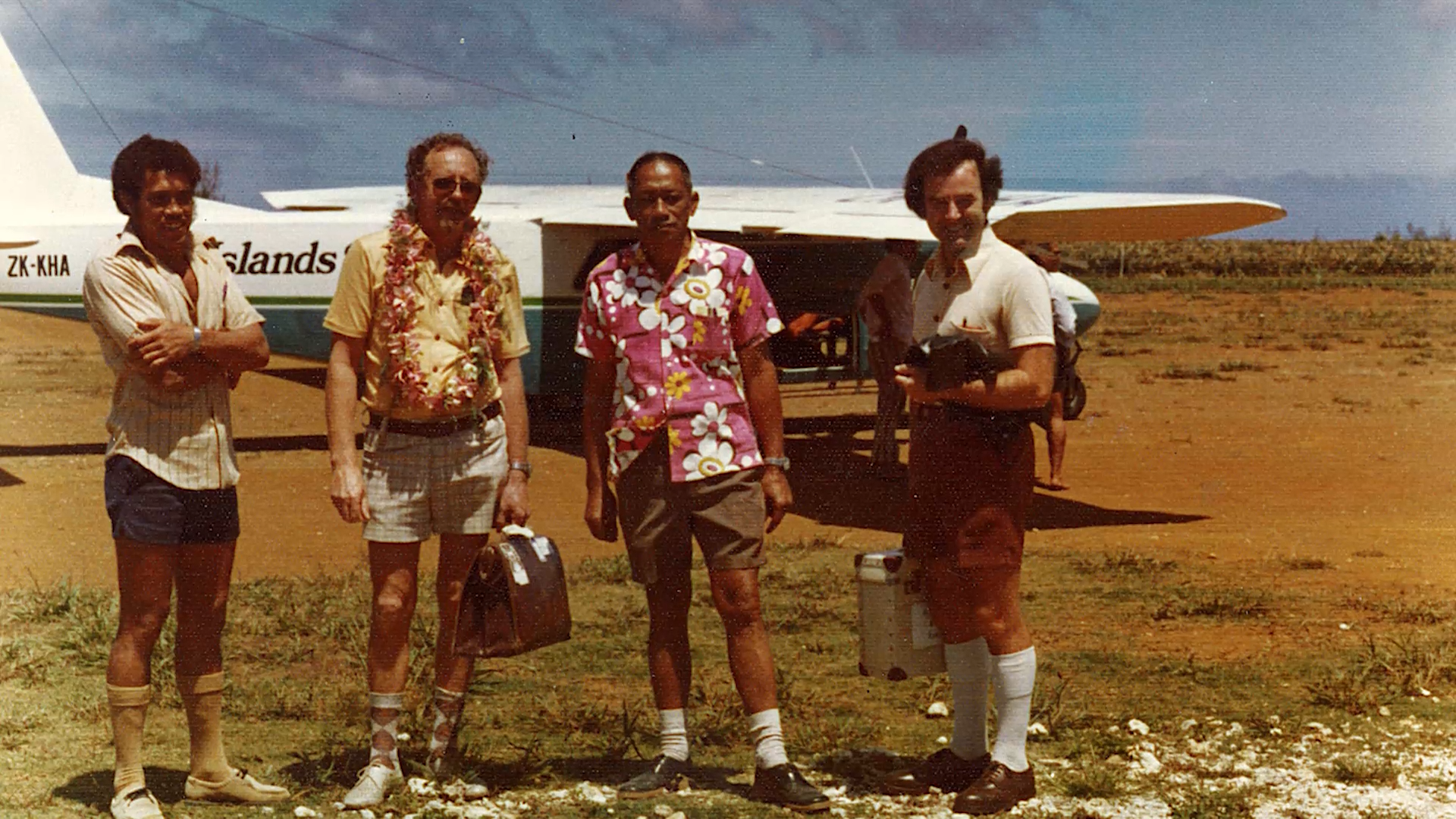
In the early 1970s, McKay made a move that was far from typical for companies in Aotearoa, New Zealand at the time. While most businesses remained focused on local projects, McKay looked outward – driven by the foresight and ambition of Joe and Tom, who recognised the potential that lay beyond New Zealand’s borders. Their willingness to explore new horizons led McKay to secure and deliver the electrical works for the Rarotonga International Airport: a significant achievement in an era without modern communication tools, reliable global supply chains, or established pathways for international contracting.
This project was more than McKay’s first offshore venture; it demonstrated McKay’s early appetite for innovation and its confidence to tackle complex challenges well outside the norm for the period. By stepping into the international arena at a time when few New Zealand firms did the same, McKay laid the groundwork for its future global reach, proving that with vision and determination, a local company could make a meaningful impact on the world stage.
Building on this momentum, the successful completion of the Rarotonga International Airport project set McKay on a path that would span three decades of continuous work throughout the Pacific Islands. What began as a single ambitious venture quickly grew into a sustained period of international engagement, with McKay returning to the region repeatedly to support critical national infrastructure projects.
Over the following years, McKay delivered five further large-scale airport developments across the Pacific, including Western Samoa in 1984, Tonga in 1987, Papua New Guinea between 1995 and 1998, and Vanuatu in 1999. These projects not only demonstrated McKay’s technical capability but also cemented trusted relationships with governments and local authorities across the region.
Alongside the airport programmes, McKay completed a wide range of essential electrical works that contributed to the growth and resilience of Pacific communities. These included the Rarotonga Cook Islands National Stadium for the 1974 South Pacific Games, the University of the South Pacific in 1975, the Rarotonga Hotel in 1977, and the installation of electrical services across all buildings and dwellings on Atiu Island in 1979. Further significant projects followed throughout the 1980s and 1990s, such as the Tuvalu Power Station (1982), the Government of Tuvalu building (1985), the Tonga Government building (1986), and later the Tongan Electric Power Board development in 1995. McKay’s presence continued into the 2000s with the Penrhyn Power Station in 2001 and the Ha‘apai Electrification Project in Tonga in 2003.
McKay in the United States
Back on home shores in New Zealand, as McKay began expanding into the marine industry in the early 2000s, further opportunities to make a global impact soon emerged. This momentum culminated in 2008 when McKay secured its first major marine project in the United States – a significant milestone that marked the company’s entry into one of the world’s largest and most competitive maritime markets.
The success of this initial project provided the foundation for establishing McKay’s USA division, a move that strengthened the company’s global presence and opened the door to long-term partnerships with leading American and international marine clients. What began as a promising venture soon developed into a sustained trans-Pacific footprint that has now spanned more than 15 years.
McKay’s contribution to the US maritime sector was formally recognised in 2015, when the American Chamber of Commerce in New Zealand shortlisted the business for Exporter of the Year to the USA ($500,001 to $5m). This acknowledgement highlighted McKay’s commitment not only to delivering quality and reliability but also to building enduring commercial relationships between New Zealand and the United States.
Over the years, McKay has been involved in a range of high-profile and technically demanding US projects. These include the delivery of the largest superyacht by volume ever built in the United States, MY Cakewalk (2010); the Spirit of Boston passenger ship (2015); the hybrid-electric RV Spirit of the Sound (2015); Atlantic Pioneer (2016); MV Abundance (2017); and MV Rachael Allen (2021), among many others. Each project has further cemented McKay’s reputation for advanced marine electrical engineering, innovation, and dependable execution.
In more recent years – though spanning the past decade – McKay’s work in the United States has been key in establishing the company as a leader in the hybridisation and electrification of vessels. With global demand accelerating for cleaner, more efficient marine solutions, McKay’s practical experience across the US market has allowed the company to refine and showcase its capabilities on a prominent international stage.
McKay in Europe
A major step in expanding McKay’s European presence came in 2015 with the acquisition of Cervina Marine Limited. This move introduced new capability and an established client base into the business, opening doors to a broader marine market. By combining the strengths of both organisations, McKay was able to support a wider range of clients, take on larger, more complex projects, and continue work on vessels it had already been involved with in other parts of the world.
Since then, teams from McKay’s Marine and Engineering divisions have spent considerable time on the ground – and on the water – throughout Europe. From the UK and Spain through to Italy and Turkey, with many shipyards and ports in between, McKay has supported a variety of well-known vessels, including MY The Spirit (54.3 m), MY Mesmerize (45.96 m), MY Aquila (85.6 m), and SY Gitana (45 m).
Today, more than 40 vessels worldwide now rely on McKay’s VCAM (Vessel Control, Alarm, and Monitoring) system. Supported by a growing portfolio and a well-established reputation for high-quality craftsmanship, McKay continues to strengthen long-standing partnerships across Europe – delivering New Zealand’s distinctive approach to marine engineering wherever it’s needed.
McKay in the Pacific Islands today
For over 50 years, McKay has played a key role in the development of infrastructure across the Pacific Islands, consistently adapting its expertise to meet the region’s evolving needs. In recent years, McKay has expanded its focus beyond traditional infrastructure to include innovative marine solutions, reinforcing its commitment to sustainable development in the region.
Recent projects across the Pacific Islands showcase McKay’s expertise in delivering long-term, high-impact infrastructure. Key initiatives include the Australian Defence Force wharf upgrades in Tuvalu and Samoa (2020), the Niue International Airport project (2024), and the Queen Salote International Wharf port upgrade (2025). These projects demonstrate McKay’s capability to deliver complex, large-scale infrastructure solutions that support the growth, resilience, and connectivity of Pacific Island communities.
In the marine sector, McKay has been leading the way in sustainable transport innovation. A standout achievement is the delivery of Samoa’s first low-carbon maritime transport solution: five solar- and battery-powered electric catamarans providing passenger transport between the villages on the islands of Manono and Namua. This project highlights McKay’s commitment to environmentally responsible engineering and practical solutions designed specifically for the unique needs of Pacific Island communities.
To strengthen its presence in the region, McKay appointed Ben Marsh as Regional Manager for Auckland and South Pacific in September 2025. This newly created role ensures dedicated leadership and a local point of contact to guide the planning, delivery, and long-term success of projects across the islands. Ben’s appointment reflects McKay’s strategic focus on sustainable development and fostering strong community relationships.