NORTHLAND REGION
McKay’s presence in the Northland region dates back to 1938, when Tom McKay formally registered McKay’s Electrical in Dargaville. In the early 1940s, the business expanded into Whangārei after Tom McKay purchased an existing electrical business on Vine Street, establishing an early foothold in the city.
Over the decades that followed, McKay continued to grow across Northland. Operating in its various forms, including both contracting and retail, the business established branches in Dargaville, Whangārei, Kaikohe, Kamo, and Kaitaia. While McKay’s regional footprint has evolved over time, Whangārei has remained the company’s primary Northland location, reflecting its long-standing role in supporting work across the wider region.
As demand for electrical services increased, Whangārei became the operational centre for much of McKay’s Northland work. Joe Faithfull was appointed to lead operations in the city, responding to growing opportunities and positioning Whangārei as a key base for regional delivery.
By 1965, managing the expanding Whangārei operation across three separate sites had become increasingly complex. The decision was made to consolidate operations into a single purpose-built facility on Water Street, located on the former gas works site. Constructed during a period of strong growth in the city following the opening of the Marsden Point Oil Refinery in 1964, the Water Street building – now McKay’s head office – was notable at the time for its scale and modern facilities.
This consolidation reflected McKay’s long-term commitment to the region and its confidence in Whangārei as a central hub for Northland operations.
Major projects delivered from Northland – including the Marsden Point Oil Refinery, Tīwai Point Aluminium Smelter, New Zealand Window Glass Limited, and others – played an important role in shaping McKay’s approach to large-scale regional delivery. Alongside the leadership of Joe Faithfull and Lindsay Faithfull, these projects helped establish the systems, relationships, and confidence that later supported McKay’s expansion into other regions, including Queenstown, Hamilton, and Auckland.
Successful delivery of long-term contracts in Northland, such as prison facilities and streetlighting, provided a practical framework that would later be replicated elsewhere in the country.
The origins of McKay Kaikohe can be traced back to project work in 2005 at the Northland Region Corrections Facility near Ngāwhā. At the time, Downer held the nationwide Department of Corrections contract, while Spotless Electrical managed maintenance. When the electrical maintenance contract went out for tender, Breen Seymour was approached by Ron Crowhurst, the prison’s Maintenance Manager at the Department of Corrections, who encouraged McKay to submit a bid.
McKay successfully secured the contract, beginning a relationship that would last for a decade. Over time, McKay was also involved in elements of the facility’s construction, including double-bunking upgrades and electrical extensions designed to increase capacity.
In its early years, Kaikohe functioned as a practical outpost rather than a fully developed branch. Equipment and whiteware were stored on site to support projects between Kerikeri and Whangārei, with a single staff member, Bruce Newson, overseeing operations while supporting regional teams.
As workloads increased, Kaikohe evolved into a reliable base of local expertise. A significant turning point came in 2016 following the loss of the Whangārei streetlighting contract. The successful tender for the Far North District Council streetlighting contract, covering 2016 to 2021, reshaped the region’s operational structure, with Kaikohe becoming a dual base supporting both prison maintenance and streetlighting delivery.
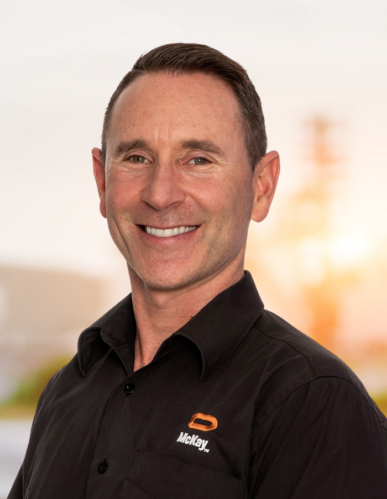
It was during this period that regional leadership transitioned from an informal structure to a more stable, locally driven model, eventually under Ross Butler. Ross’s path into the electrical industry was unconventional, beginning with a career as a marine biologist in the United States before transitioning into electrical engineering work.
After returning to Aotearoa, New Zealand, Ross joined McKay and progressed through a wide range of roles, from marine and contracting work to project management and leadership. His experience across multiple departments contributed to the development of strong regional capability and delivery consistency throughout Northland.
Ross’s influence can be seen across the region, from streetlighting delivery to long-term prison maintenance and the establishment of reliable local teams. As he reflects, “You just went to whatever departments needed someone. But it meant you had a variety of experience and a wealth of knowledge.”
Northland has become a blueprint for McKay’s regional development, demonstrating how a strong local presence can shape long-term success nationwide.