
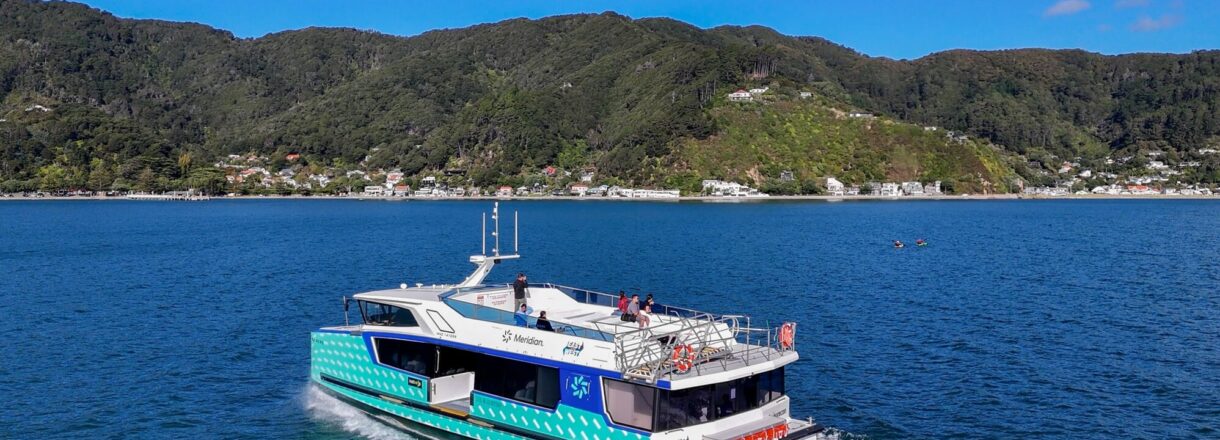
Ika Rere is a 28-tonne, 19-metre, carbon fibre, twin-hull vessel designed to carry up to 132 passengers at speeds of up to 20 knots. Fully electric by design, the ferry is powered by two independently supplied 325kW liquid-cooled electric AC motors, one located in each hull. Energy is stored across two banks of liquid-cooled lithium-ion batteries, with a total weight of 5,500kg and an installed capacity of 550kWh, enabling efficient, high-performance electric propulsion.
Propulsion and energy storage are managed through an integrated Danfoss Editron system. Each hull is equipped with a Danfoss EM-PMI1540-T200 motor, rated at 325kW, driven by a Danfoss EC-C1200-450 DC-AC converter. Each motor operates from its own 750V DC bus, complete with independent charging connections that provide the redundancy required for maritime operations. Each DC bus is supplied by three EC-C1200-450 converters operating in DC-DC mode, with power drawn from battery strings consisting of XALT XMP76P battery packs. In total, 72 battery packs are installed, and the system is designed to allow future upgrades to XALT XMP98P packs, delivering an estimated 29% increase in capacity and operational range.
Digital monitoring and control of the vessel is delivered through McKay’s Vessel Control, Alarm, and Monitoring (VCAM) system, integrated with industry-standard SIMRAD propulsion levers and dual touchscreen graphical displays. VCAM provides real-time visibility of vessel power, performance, speed, range, temperatures, pressures, and system notifications, with communications managed via CAN bus and other standard maritime protocols. Independent power and battery states for each hull are displayed graphically, alongside guided start-up and shutdown checklists that support safe operation.
Operational range varies depending on sea conditions, battery age, vessel speed, and passenger load. At full capacity, a return journey between Wellington’s Queens Wharf and Days Bay at 20 knots consumes approximately 310kWh, reaching safe battery operating limits after 42 minutes. VCAM continuously calculates and presents real-time range estimates to the vessel master, factoring in battery state of charge, live power usage, passenger load, and prevailing maritime conditions.